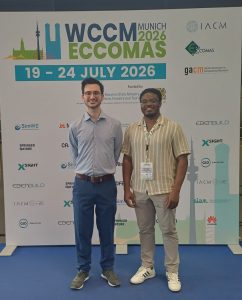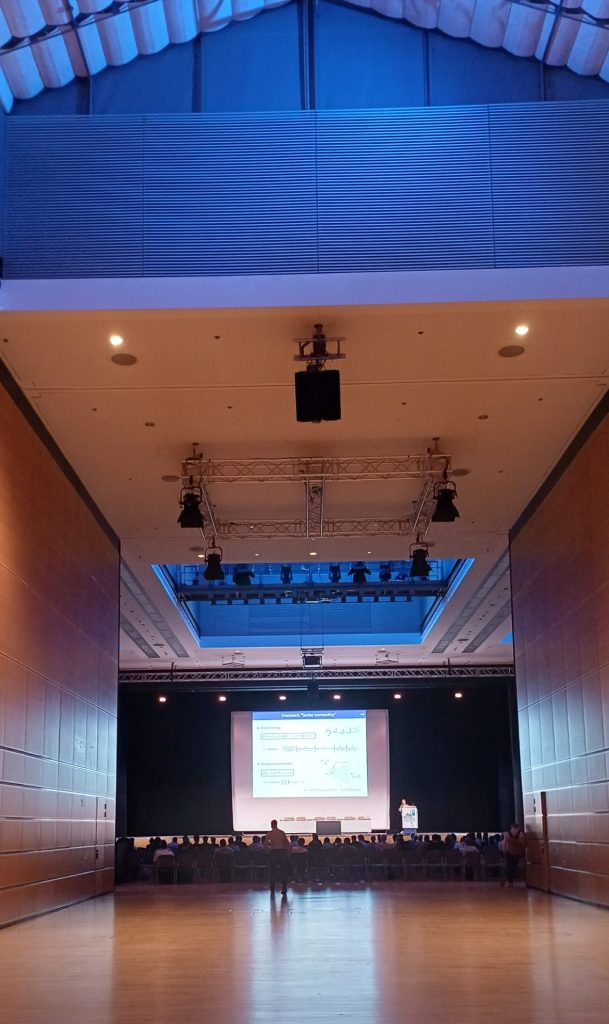
We are pleased to share the participation of two members of our group, René Thierry Djoumessi and Lorenzo Zoboli in the WCCM 2026–ECCOMAS Congress, a major international meeting for researchers working in computational mechanics, held in Munich, Germany, from 19 to 23 July 2026.
During the conference:
-
Dr. Djoumessi presented the work entitled “A multiscale electromechanical-contact framework for intestinal motility” which focuses on the mathematical and computational modelling of the gastrointestinal tract. The study brings together several key aspects of gastrointestinal function within a single computational framework. These include electrophysiology, the complex mechanical behaviour of soft biological tissues, and the interaction between different tissue surfaces.
To represent the highly nonlinear and direction-dependent response of gastrointestinal tissues, the model uses advanced hyperelastic constitutive laws capable of describing their fibre-reinforced structure. A customised augmented Lagrangian algorithm was also developed to manage both internal and external contact, an essential feature for realistically simulating the large deformations and complex interactions that occur within the gastrointestinal system.
- Dr. Zoboli presented the work entitled “Peridynamic modeling of bioresorbable screw degradation”. The study explores how magnesium-alloy orthopedic screws gradually degrade inside the body, using an advanced computational approach based on Peridynamics. The model introduces a corrosion current that varies both in space and time, allowing uniform degradation and localized, pitting-like surface roughening to be described within the same framework.The model was tuned against experimental data for an Mg–10Gd screw immersed in a physiological-like environment and was used to investigate its volume loss, surface evolution, and surrounding magnesium-ion concentration over 60 days. The work also considered how different regions of an implanted screw may experience different degradation rates depending on their exposure to cortical bone, trabecular bone, or surrounding tissues.
This framework provides a promising basis for future models coupling corrosion with mechanics and bone remodelling.
Their participation reflects our continued commitment to scientific exchange, international collaboration, and the development of innovative computational approaches to challenging engineering problems.
We look forward to building on these discussions and developing connections for future research collaborations.