Abstract
This project investigates the degradation and mechanical performance of bioabsorbable magnesium-alloy fixation screws. The research at TcBiomech has addressed peridynamic (PD) modelling of corrosion and the fatigue assessment of degrading implants. Complementary work at the University of Rome Tor Vergata has developed phase-field modelling of screw degradation. The TcBiomech peridynamic study extends an FFT-accelerated corrosion model to represent spatially and temporally varying dissolution, including localized current-density peaks that generate pit-like surface changes. Simulations of an Mg-10Gd screw are compared with in vitro volume-loss measurements and used to examine ion concentration, surface morphology, and the influence of heterogeneous exposure. In the fatigue study, the mechanical response of progressively degraded screw geometries is evaluated under cyclic loading to estimate how resistance changes over time. Together, these activities establish complementary ways to study material loss and its mechanical consequences. Bone remodelling has not yet been included: the current work does not simulate the growth or adaptation of the surrounding tissue as the implant dissolves.
Objectives
TcBiomech’s principal objective is to improve the description of corrosion in three-dimensional bioabsorbable screws, with particular attention to the location and consequences of material loss. A global volume-loss curve is essential for comparison with experiments, but it does not show whether degradation is spread across the surface or concentrated in regions that may become mechanically critical. The peridynamic work therefore aims to represent uniform and localized dissolution within one computational framework, compare their effects on screw geometry, and characterize the evolution of ion concentration and surface roughness. Experimental measurements on Mg–Gd screws provide the reference for assessing the predicted degradation trend.
A related objective is to determine how the evolving geometry affects fatigue resistance. This requires mechanical evaluation at successive degradation stages, under loading conditions that distinguish the effects of axial force, bending, and preload. The longer-term aim is to connect the spatial detail of the peridynamic corrosion model with mechanical assessment, so that localized corrosion can be examined for its effect on stress concentration and fatigue life. Improving the definition of corrosion hotspots independently of the computational grid, testing numerical sensitivity, and obtaining fatigue data for the specific alloys studied are further steps toward that aim. These are development objectives; the present studies have not yet established a fully coupled model in which stress alters corrosion and corrosion continuously alters the mechanical response.
Methodology
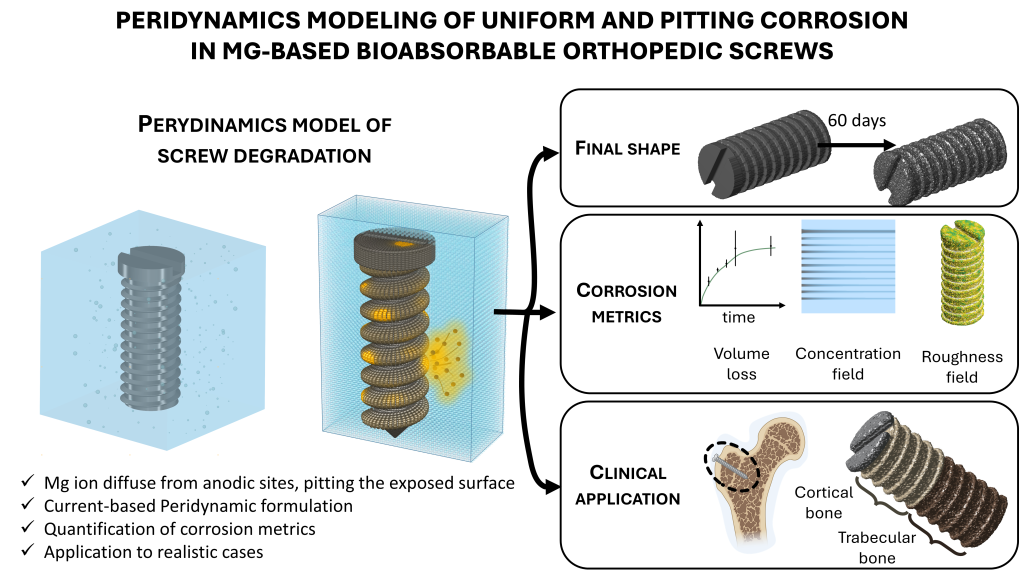
For the corrosion analysis, TcBiomech developed a three-dimensional model from the PeriFast/Corrosion peridynamic code, which uses fast Fourier transforms to accelerate the calculation of nonlocal interactions. The computational domain contains the screw and a surrounding liquid. As magnesium dissolves at their evolving interface, released ions diffuse through the liquid and the solid region progressively recedes. Dissolution is governed by a current density that varies in time and across the screw: a background value represents broadly distributed corrosion, while higher values assigned to selected locations represent localized activity. Simulations with and without these peaks allow the effects of the two corrosion patterns to be compared under specified parameter choices.
The model was applied to an Mg-10Gd screw immersed in a biomimetic medium over a 60-day simulation interval. Parameters were selected with reference to the literature and calibrated against available in vitro volume-loss measurements. UCBM examined the resulting volume-loss curves, three-dimensional screw shapes, ion-concentration fields, and local surface-roughness measures. Repeating the simulation with different random placements of current-density peaks provided an initial assessment of their effect on the global result. A further demonstration assigned different current-density distributions to regions representing the exposed head and portions surrounded by cortical or trabecular bone; the bone itself was not explicitly modelled.
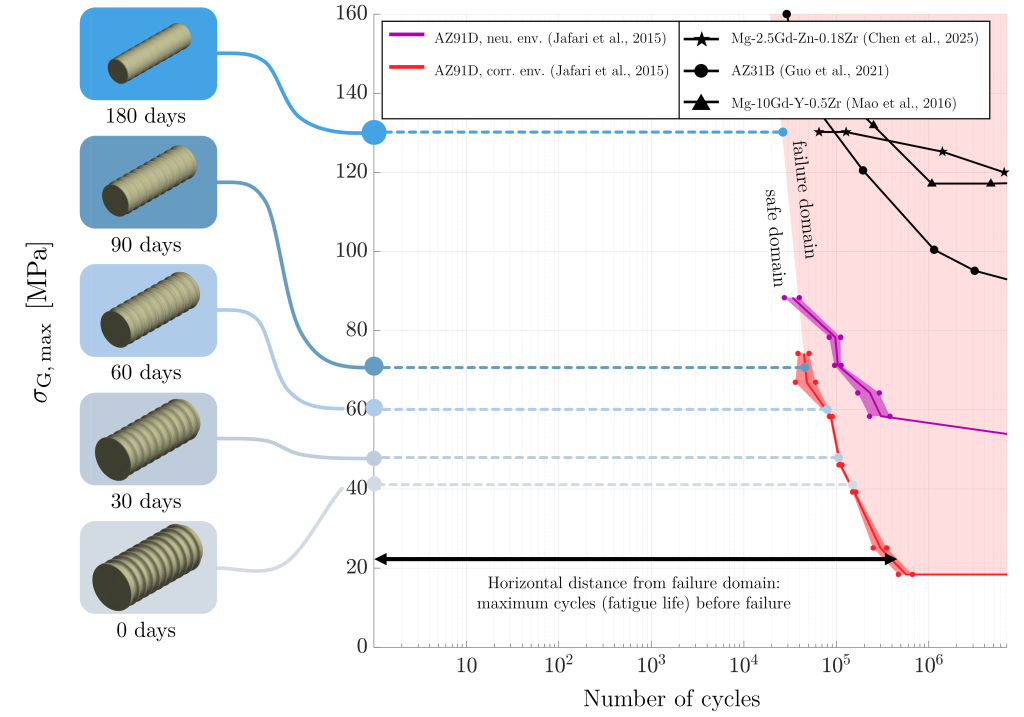
Fatigue was assessed in a separate, sequential analysis of screw geometries at selected stages of degradation. Finite-element calculations estimated stresses under cyclic axial and bending loads, including cases with axial preload. The resulting stress measures were compared with available experimental stress–life data to estimate allowable cycles and to relate them to assumed levels of implant use. This procedure evaluates how prior degradation affects fatigue resistance. Mechanical stresses do not feed back into the corrosion calculation in the current implementation.
Expected / Achieved Results
The UCBM peridynamic simulations reproduced the main trend of the experimentally observed volume loss of an Mg-10Gd screw over the studied degradation interval. They also showed why the spatial pattern of corrosion matters. Under the parameter choices examined, localized peaks in dissolution current produced greater material loss and a more irregular surface than uniform-current cases. The computed concentration field reflected features of the screw geometry, while roughness measures helped characterize changes that a volume-loss curve alone cannot capture. Simulations with three different random peak distributions gave similar global degradation trends, although a broader statistical assessment of local corrosion patterns remains necessary.
The model also demonstrated a way to prescribe different corrosion conditions along one screw. In an illustrative implanted configuration, the exposed head underwent more severe dissolution than the portions assigned lower corrosion activity. This result shows that the model can explore spatially heterogeneous exposure; it is not a prediction validated for an implant inside living bone. Local geometric predictions also remain limited by the computational resolution and by the current grid-based definition of the corrosion peaks.
In the complementary fatigue work, mechanical stresses increased and estimated allowable fatigue cycles decreased as the screw geometry degraded. Bending produced a more demanding response than axial loading in the scenarios considered. The analysis demonstrated how degradation stage and assumed usage could be combined to estimate when fatigue failure risk becomes critical. Those estimates are illustrative because the mechanical model uses simplified geometry and loading conditions, and some comparisons rely on stress–life measurements for a magnesium alloy other than the Mg–Gd screw studied. The results obtained so far establish separate corrosion and stagewise fatigue capabilities. A coupled peridynamic corrosion–fatigue simulation and a model of bone remodelling remain to be developed.